
Press release
Study proves that additive manufacturing saves resources and reduces emissions in the fashion industry
AMGTA Lifecycle Research report highlights the collaboration between Stratasys and Dyloan Bond Factory, part of the Pattern Group, to compare additive manufacturing to traditional manufacturing processes. The study found that Stratasys’ PolyJet™ process can reduce CO2e emissions by 24.8% compared to injection molding and achieve 48% inventory savings across the supply chain.
Stratasys has shared the results of a study commissioned by the Additive Manufacturer Green Trade Association (AMGTA) that demonstrates the environmental benefits of additive manufacturing for the fashion industry.
The report, “Comparative Analysis: 3D Material Jetting vs Traditional Methods for Designer Luxury Goods,” presents the results of a year-long collaboration between AMGTA, Stratasys, and DYLOAN Bond Factory, a member of the Pattern Group, the leading Italian center for luxury fashion design and manufacturing. The English summary is available at https://www.stratasys.com/en/about-us/sustainability/.
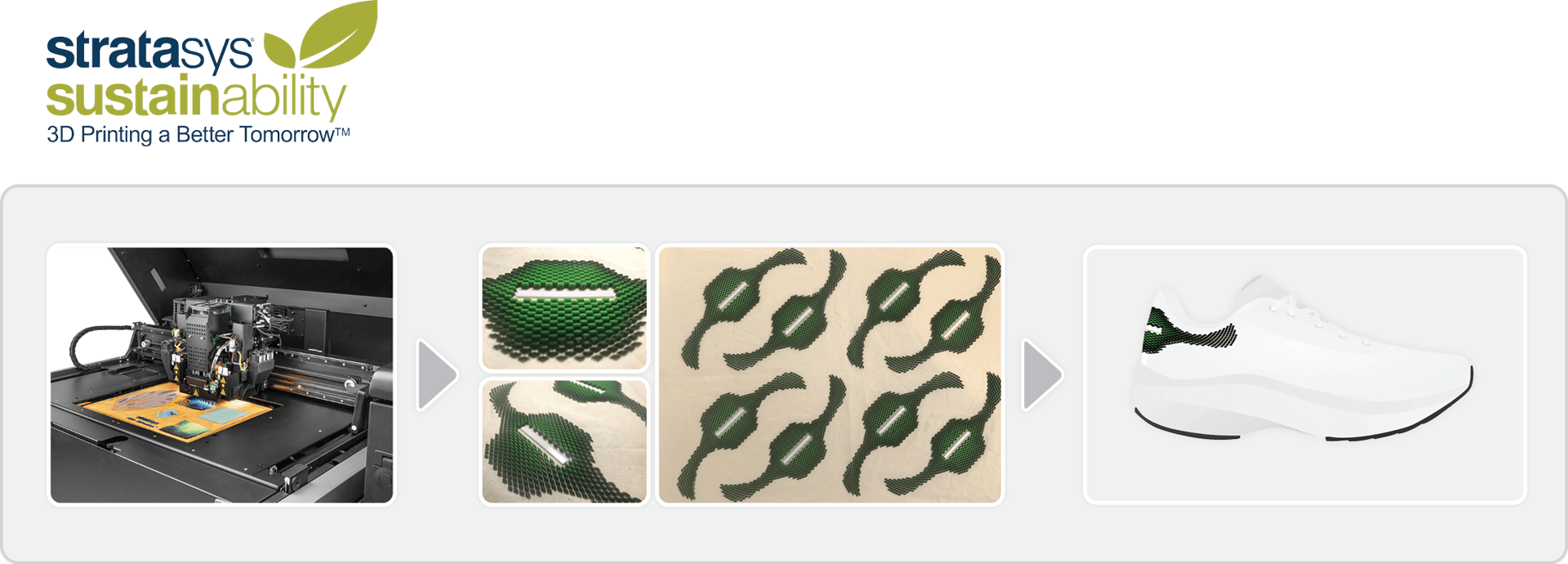
The use case study examined the transition from traditional manufacturing methods to advanced additive manufacturing: the goal was to create 16,000 logo appliqués for 8,000 pairs of luxury designer shoes, printed on fabric, produced using the innovative Stratasys J850™ Fashion TechStyle™ printer.
The results of the study revealed the following: Additive Manufacturing (AM) with Print-to-textile technology reduces CO2e emissions by 24.8% compared to the customer’s traditional processes.
Considering the customer’s production volume (16,000 printed logos for 8,000 pairs of shoes), additive manufacturing can save almost one ton of CO2e.
AM Print-to-textile technology can save 49.9% of inventory across the entire supply chain, reducing and streamlining transportation needs.
Direct-to-textile printing with the J850™ TechStyle™ 3D printer is a water-free process across the entire measured supply chain, saving over 300,000 liters of water.
Additive manufacturing reduces electricity consumption by over 64%.
The transition to additive manufacturing reduces supply chain dependency from 4 technologies to 1: with a single additive workflow, transportation and logistics are eliminated for 3 processes.
The transition to additive manufacturing simplifies production and logistics “stages” from 12 to 2.
The research was conducted by Reeves Insight and reviewed by experts from the ACAM Aachen Center for Additive Manufacturing GmbH.
“Sustainable production is becoming increasingly important for designers in the luxury world, and this is particularly important for Pattern Group’s Dyloan Bond Factory,” said Loreto Di Rienzo, Director of Research and Development at Pattern Group. “Stratasys’ innovation in 3D printing, particularly with TechStyle™ technology, allows us to offer revolutionary solutions by reducing waste, minimizing our dependence on natural resources, and optimizing the environmental impact of our entire supply chain.”
Sherri Monroe, Executive Director of AMGTA, said: “We are pleased to release the third research paper in a series of papers designed to explore the environmental benefits of implementing additive manufacturing. We are committed to creating research and publications that help us better understand the sustainability value of AM technologies in manufacturing processes. The Stratasys-Dyloan Bond Factory Fashion LifeCycle Analysis (LCA), which analyzes the impact of print-to-textile technology, is our first polymer study. It provides important data that supports the value of AM in influencing one of the world’s most polluting industries.”
This report demonstrates Stratasys’ commitment to Mindful Manufacturing™, an approach that advocates for sustainability, efficiency, and innovation to 3D Print a Better Tomorrow™. Environmental considerations are paramount and can have a real impact on business outcomes. Together with its customers, Stratasys is rethinking how things are made; redesigning processes, products, and components; and optimizing operations for the benefit of people and the planet.
Stratasys invites its customers, partners, and those interested in 3D Printing for a Better Tomorrow™ to join the company on its journey towards more sustainable manufacturing. For more information about Stratasys and its commitment to Mindful Manufacturing™, visit https://www.stratasys.com/en/about-us/sustainability/
Learn about direct-to-textile 3D printing!
Download the 8-page brochure in English!