
New Stratasys H350 3D printer designed for industrial additive manufacturing
The Stratasys H350 3D printer with SAF technology is designed to deliver consistent, accurate, and production-quality parts at an affordable and predictable cost. SAF technology produces end-use parts faster and more accurately than traditional manufacturing technologies or competitive 3D printers. The H350 printer also includes approximately a dozen parts printed with SAF technology.
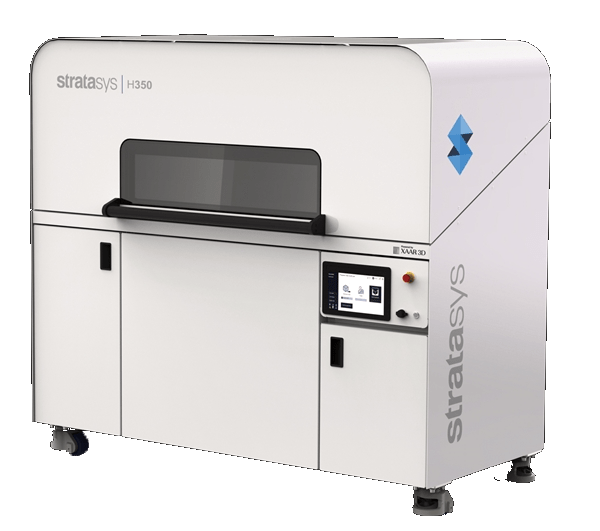
Stratasys, a leading manufacturer of polymer 3D printing solutions, today introduced the Stratasys H350™ additive manufacturing system, the first 3D printer in Stratasys’ new H-Series manufacturing platform. Powered by SAF™ technology, the new H350 3D printer is capable of producing high-volume end-user parts. It is designed to provide manufacturers with consistent, competitive and predictable part costs and to enable mass production of parts under controlled conditions. The H350 printer includes approximately a dozen parts printed with SAF technology. The 3D printer is expected to begin shipping in the third quarter of 2021.
“We see the application of 3D printing in mass production transforming the entire manufacturing industry, allowing companies to produce with greater flexibility,” said Omer Krieger, executive vice president of product strategy and corporate development at Stratasys.
“We believe that the H350 and SAF technology stand out from traditional manufacturing methods and alternative 3D printing solutions when it comes to reliably and repeatably producing thousands of parts with compelling economics.”
Stratasys shared details about SAF technology in March. This industrial-grade additive manufacturing technology performs key 3D printing steps on the print bed in two phases but in the same direction, ensuring even heat distribution and consistency for all printed parts, regardless of where they are located on the print bed. SAF can also contribute to lower operating costs and increase predictability. For example, the Big Wave™ powder management system reduces powder aging, while the warranted, industrial piezoelectric print heads are designed to not require regular replacement.
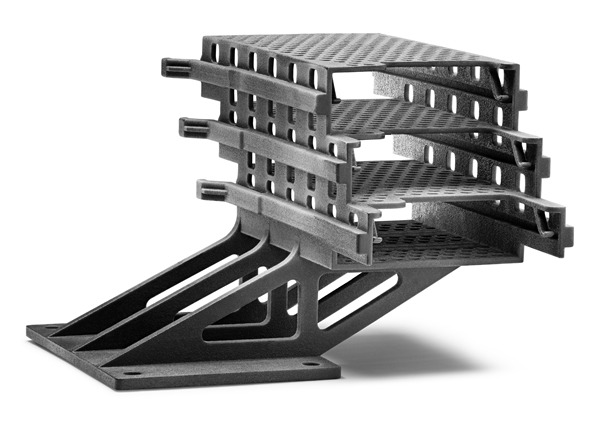
The Stratasys H350 3D printer is designed to meet the needs of customers in industries such as automotive, commercial, consumer, and electronics manufacturing who benefit from the ability to produce large volumes of 3D printed parts quickly, at a predictable cost, and economically. 3D printing service companies and contract manufacturers also benefit from the system’s industrial-grade performance. Its recommended applications include the production of end-user components such as enclosures, connectors, hinges, cable trays, electronic housings, and conduits.
German 3D printing services company Goetz Maschinenbau was one of those beta testing the H350 3D printer.
The company uses the H350’s new SAF technology to produce parts for customers in the automotive, consumer goods and medical device industries, in addition to its existing Stratasys FDM and PolyJet systems.
The launch of a new SAF-based 3D printer represents a significant growth opportunity for the company, as it is not only capable of replacing CNC machining but also of directly manufacturing end-user parts.
“We have ambitious plans to expand our business and believe that the Stratasys H350 will be a key element in this growth,” said Philipp Goetz, owner of Goetz Maschinenbau. “With the H350, we have been able to fulfill both large-scale part orders and orders of hundreds of smaller parts. We were impressed by the performance of the system and the SAF technology, the consistent quality of the parts and the repeatability that this technology provides. The system has proven to be extremely reliable.”
The H350 offers a range of control features for companies ready to transition to additive manufacturing. All production data is logged for complete process traceability and remains under the user’s control. Printing parameters can be fine-tuned as needed and the manufacturing process can be monitored throughout.
Well-utilized workspace
SAF technology enables an average 12% utilization of the work space, compared to the 6-10% typical for powder bed fusion 3D printers. In some productions, Stratasys was ableto achieve a ratio of up to 23.5% under real-world conditions. Increasing the space utilization increases the number of parts that can be produced at one time or reduces production time.
Raw material
Stratasys uses certified, third-party raw materials for its H-Series systems. The starting material is Stratasys High Yield PA11, a sustainable, bio-based plastic made from castor oil. Compared to PA12, PA11 is less polluting, has excellent heat resistance, and is less brittle, making it less brittle. The newly introduced material has already passed ISO 10993-5 cytotoxicity and UL94 HB flammability tests. Stratasys plans to introduce a number of certified polymer raw materials in the long term to take advantage of the benefits of SAF technology.
Software
Recognizing the importance of enterprise connectivity for production management, H350 customers can integrate their machine with their manufacturing management system using the MT Connect standard. The Stratasys H350 is compatible with Materialise Magics, Siemens NX and PTC Creo software, complete with the Stratasys Build Processor. Stratasys will also offer GrabCAD Print support for 3D printing preparation in the future.