
Learn more about integrating FDM 3D printed tools!
Download the 13-page composite 3D printing solution guide in Hungarian!
Understanding the Key Differences Between Stratasys FDM and FFF 3D Printing
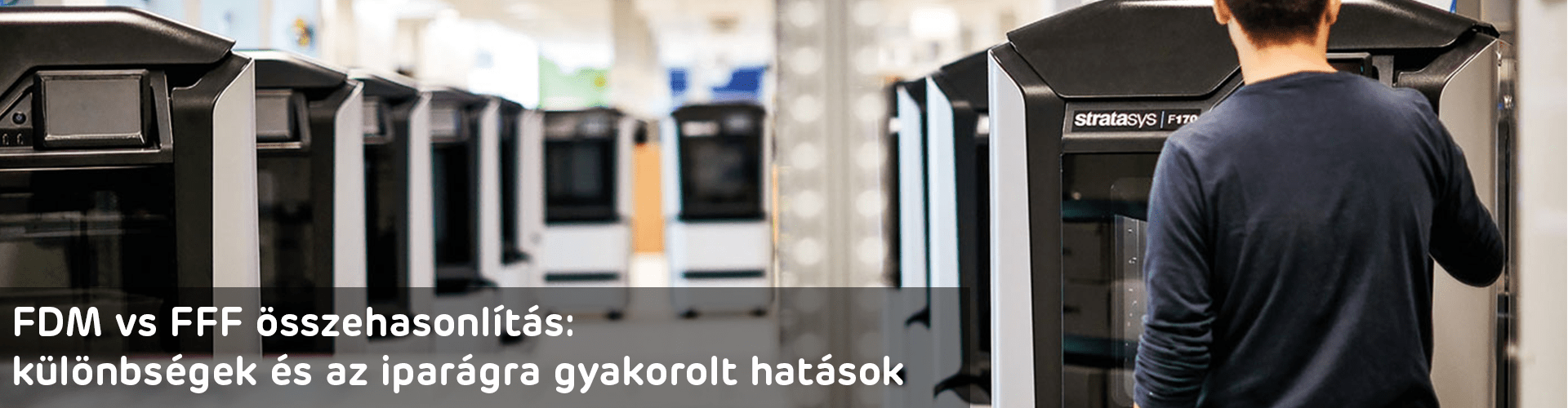
Glossary and Origin: FDM , or Fused Deposition Modeling, is a patented technology developed by Stratasys that has received 1,820 patent applications over the past 30 years, of which 1,380 are active, and Stratasys has trademarked the term. Fused Filament Fabrication (FFF) is also a technology based on melting plastic filaments, but does not use the innovations that Stratasys has patented.
3D Printing Equipment:
Despite the differences in names, the basic concept behind FDM and FFF is the same. Both methods use a nozzle to spray molten thermoplastic onto a surface to build up objects layer by layer. The primary difference lies in the equipment used for printing and their technological sophistication. Stratasys FDM technology 3D printers specifically designed and manufactured by Stratasys , which are built around providing the environmental parameters necessary for processing plastic, while FFF technology is open source, allowing different manufacturers to produce compatible 3D printers, primarily for processing materials that do not require special environmental parameters.
Material selection:
Another significant difference between Stratasys FDM and FFF lies in the technological quality of the material processing. Stratasys FDM printers support a wider range of high-performance and engineering-grade thermoplastics, including Antero (PEKK) and ULTEM™ (PEI). These materials have excellent mechanical properties, heat resistance and chemical resistance, thus meeting strict aerospace, automotive and healthcare regulations. In contrast, FFF printers typically offer a narrower selection of engineering and high-temperature materials, most suitable for printing PLA, PETG, but even this does not guarantee successful production and repeatability, i.e. the ability to repeatedly produce a given part with the same quality.
Print Quality and Accuracy:
Stratasys FDM 3D printers are known for their high accuracy and print quality thanks to their controlled manufacturing process and advanced technology. These 3D printers have at least two print heads, which allows the use of support material to print complex geometries. The result is ready-to-use products that require minimal post-processing, quickly, on time, and with repeatability that meets industry demands. FFF printers show a wide variation in print quality and accuracy.
Costs and Affordability:
Stratasys targets industries where production line uptime is a top priority, as well as industries that may require high-end solutions. Stratasys and VARINEX are recognized for their commitment to quality and product support. In contrast, FFF 3D printers are popular with hobbyists, educators, and small businesses due to their lower price, for whom we recommend https://makerbotshop.hu , where they can choose from high-quality UltiMaker FFF 3D printers.
Summary:
Stratasys FDM technology usually brings tens of thousands of euros in monthly returns to companies interested in manufacturing, because it is suitable for applications that FFF technology does not, or only to a very limited extent. At the same time, FFF offers a more accessible and affordable entry point into the world of 3D printing, which appeals to a wider range of users. Regardless, it is not possible to judge based on the experience gained with FFF technology what application possibilities a Stratasys FDM 3D printer has for a given company, because the basic principle of the two technologies is the same, but the possibilities for their use are completely different. Undoubtedly, both FDM and FFF played a significant role in the development of the world of additive manufacturing.
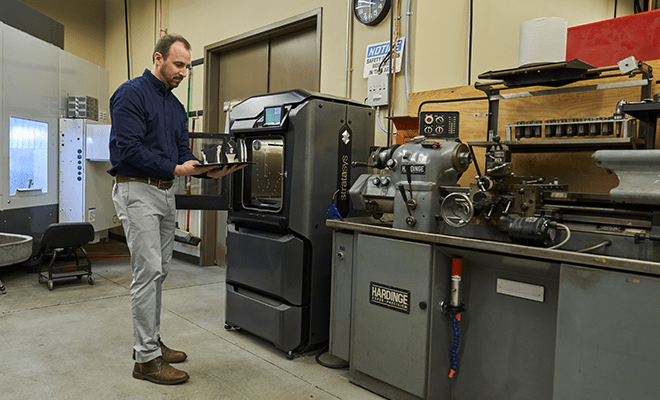
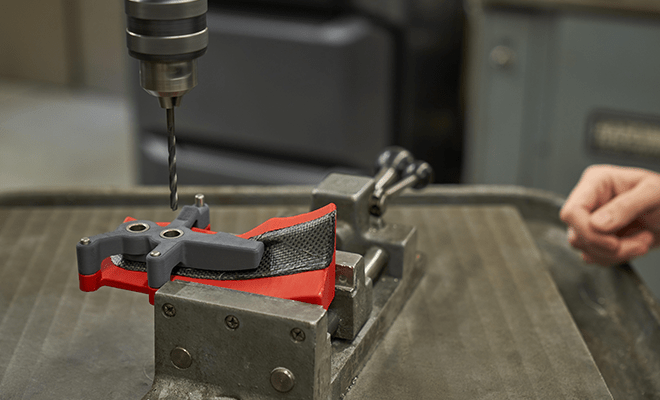
Learn more about integrating FDM 3D printed tools!
Download the 13-page composite 3D printing solution guide in Hungarian!