
Thinking big? How the F770 meets the challenges of large-format 3D printing
One of the biggest advantages of industrial 3D printing is speed and flexibility: a necessary spare part, production support tool or prototype can be produced in a significantly shorter time than with traditional manufacturing technologies.
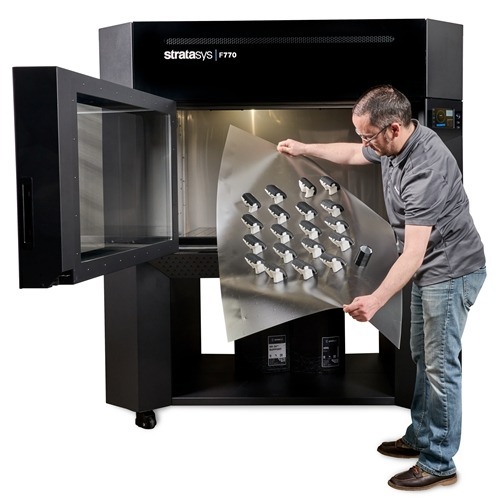
But what happens when the component itself is large?
Large-format additive manufacturing poses a completely different challenge for the technology. The larger a part, the longer it takes to produce and the more raw materials it requires. For a print run that lasts several days, it is critical that the system has sufficient raw material capacity and can operate reliably without supervision.
As the size increases, part stability becomes increasingly important. For tall geometries, vibrations during printing can cause dimensional accuracy issues, which can be addressed with appropriate support structures and stabilizing walls.
Equally important is the right temperature environment. If there are significant temperature differences at different points in the build space, this can cause internal stress, bending and warping – especially for large and tall parts.
With the right settings, we can gain a lot
The successful production of large-scale parts depends not only on the 3D printer. The correct orientation, infill density and layer thickness can significantly influence the production time, material consumption, mechanical strength and surface quality.
If speed is a primary concern, higher layer thicknesses or lower infill density can shorten production time. However, if the appearance of the part is also important, using different layer thicknesses in different areas can create a balance between speed and surface quality. The choice of support material also significantly affects post-processing. Dissolvable support material is especially advantageous for complex geometries and internal channels, while manual removal can be a faster solution in easily accessible areas.
Stratasys F770: specifically for large format tasks
The Stratasys F770™ is designed specifically for reliable, large-format 3D printing. With a build volume of nearly 370 liters, the system is capable of producing parts up to 1170 mm long in a single piece.
However, the F770 is not simply a larger 3D printer. Its technical solutions are designed to address the problems that become critical when manufacturing large parts.
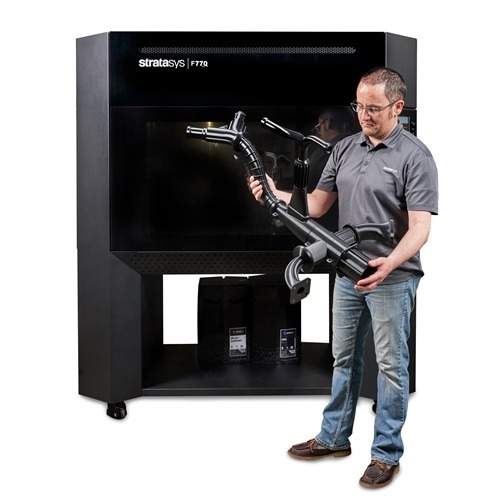
Long print? High material capacity
The production of a large-format part can take up to several days, so it is especially important that the process is not interrupted by running out of material. The F770's material cartridges each contain nearly 3.3 liters of material, allowing for up to 140 hours of continuous printing.
Complex geometry? Soluble support material
A large-format part doesn’t necessarily mean simple geometry. The F770’s removable support material allows parts with overhangs, complex shapes or internal channels to be manufactured safely and provides greater design freedom.
Speed or surface quality? Or both?
The F770 offers three selectable layer thicknesses, allowing you to tailor settings to your application requirements. GrabCAD Print™ and Insight™ software provide additional options for optimizing your production process.
For example, Adaptive Slice changes the layer thickness according to the geometry of the part, accelerating production where possible and using finer layers where detail demands it. Infill density can also be adjusted to the application, optimizing the balance between strength, production time and material usage.
Large component? Controlled temperature
The F770’s fully heated build chamber ensures a consistent temperature environment throughout the entire build volume. This is especially important for large-format parts, as it significantly reduces the risk of warping and warping.
In one piece where previously several parts were needed
Perhaps one of the biggest advantages of the F770 lies precisely in this.
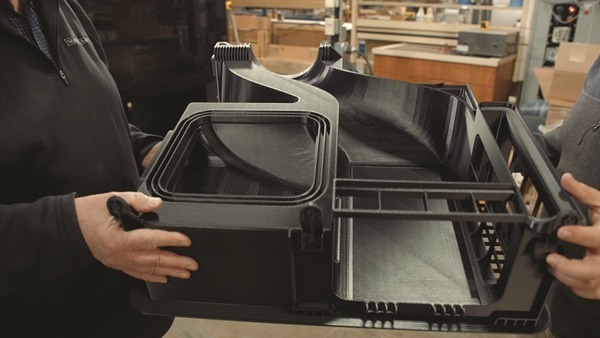
With a smaller 3D printer, large parts have to be broken down into multiple parts, manufactured separately, and then assembled and secured. This already means extra work during the design phase, and assembly requires additional post-processing and time. The large build volume of the F770 allows the same parts to be manufactured in one piece in many cases. This can be particularly beneficial for large-format prototypes, production support devices and tools.
Curious about how the F770 can be integrated into your company's development or manufacturing processes? Contact VARINEX experts and we will help you find the right solution for your application.
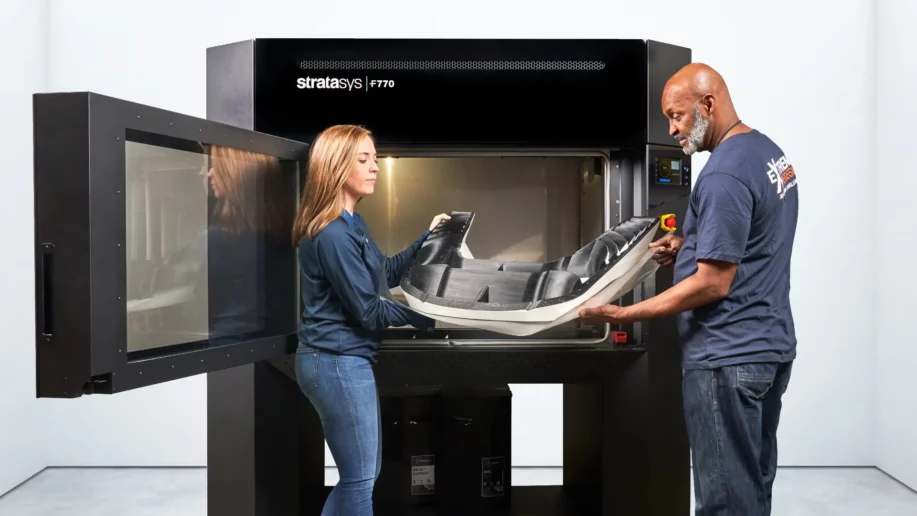
If you would like to learn about effective solutions to the challenges of large-format 3D printing, download our brochure!