

Märklin transforms its production line with 3D printed tools
Märklin is known worldwide for its accurate, lifelike model railways. However, designing, building and manufacturing a miniature train is no small undertaking.
Producing a single model railroad requires numerous production stages, from zinc casting and galvanizing to CNC milling and pad printing, to fabrication, assembly, and hand painting. The multi-step, time-consuming process requires expensive, custom-made production line tools.
The company recognized that tool manufacturing using traditional methods was time-consuming and costly, which it had to manage, and turned to 3D printing as a solution: Märklin Stratasys FDM® and PolyJet™ technology.
Modern manufacturing of customized production tools
The production of individual assembly tools using CNC milling was extremely labor-intensive and expensive, and did not allow for rework or development, which slowed down the production line. As a solution, Märklin installed industrial Stratasys 3D printers to produce tools, production line fixtures and seats. 3D printing has almost completely replaced traditional methods of manufacturing assembly tools in some areas.
“We quickly recognized the benefits of 3D printing, especially the flexibility of production, which accelerated the production time of the parts,” said Michael Zauner, project manager and innovation manager at Märklin. “3D printing allows us to produce a custom tool in one day instead of several weeks, so that employees can focus on producing the model trains instead of making the tools. In addition, 3D printing also offers greater design freedom.”

Making production more flexible
Model railway manufacturing is a multi-step process that requires flexible and easy-to-use tools. One example is the production of clamps used in digital printing. In this process, the model train casing is printed (labeled) with the desired pattern for maximum authenticity. Using traditional CNC-milled steel clamps, the quality of the printed models deteriorates as the high pressure applied stresses them. In contrast, durable but lightweight 3D printed clamps hold the train components in place without damage.
“Rethinking the way we make tools was a central issue for the production line and our design team. In addition to FDM technology , we also started using PolyJet technology to manufacture the fixtures and seats on the production line. Being able to combine soft and hard materials in a single print gives us previously unknown tooling possibilities,” explained Zauner.

Expanding possibilities with 3D printing
3D printed designs are stored digitally and can be easily reproduced or adapted, giving the company greater flexibility and speed in modifying tools and adapting them to model railroads or manufacturing processes.
3D printing has made it possible to add tool and destination labels to CAD designs at no additional cost. This allows printed parts to be clearly identified and assigned to the correct step during production, resulting in improved manufacturing workflows.
“Our employees are now looking for more things they can 3D print,” said Zauner. “They’ve seen the benefits in their own work and in manufacturing as a whole. 3D printing makes manufacturing more efficient while giving employees time to come up with new ideas, which has opened up countless new opportunities for us.”

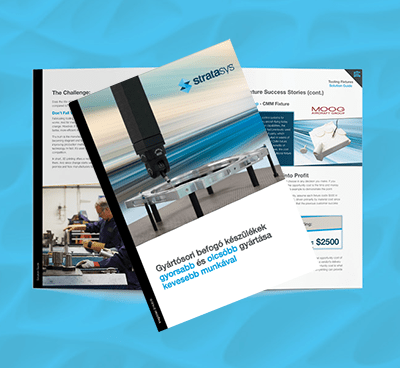
Learn how additive manufacturing can bring new momentum to the fixture manufacturing process while increasing time and cost savings!
Download the 12-page, Hungarian-language
FASTER AND CHEAPER PRODUCTION OF PRODUCTION LINE HOLDING
entitled!